Turning My Dad’s Last Days Into Moments of Love and Connection
Two years ago, I went to visit my parents and found my father in bed at 6 PM, clearly unwell. He was weak, suffering from abdominal pain, and hadn’t passed a bowel movement in days. Initially, my mom seemed convinced it wasn’t as serious as it looked. To be fair, my dad had a history of exaggerating ailments to gain a bit of sympathy, so it wasn’t completely out of left field for her to wonder if this was another one of those times. But something about it felt different to me, and when he hadn’t improved a couple of days later, I insisted we take him to the hospital. Turns out he had a tumor in his bowel. The doctors performed a life-saving surgery that resulted in a colostomy bag—an entirely new reality for all of us. Fortunately, I’m not squeamish, and I was able to pitch in and help care for him. He was in rough shape—sore, miserable, and suddenly living a life none of us could have imagined. But he was alive!
Before this, we’d been a social family—always gathering, always welcoming. But after his surgery, my dad wasn’t able to be social – he even told the grandkids not to come over for Christmas. At the time, I held some concern… but also resentment, especially since my son, Alexander, was supposed to stay with them and suddenly he was unwelcome. Tragically, Alexander later took his own life, and I’ve always wondered if feeling rejected contributed to his despair. But my father had been so sick and overwhelmed; he needed peace, privacy and solitude to heal, or at least to survive day-to-day. By the time I lost my son, Dad’s health had improved somewhat, and my parents didn’t miss a beat in welcoming me to their home as I worked through my grief.
As my dad continued to adjust following his surgery, his taste buds went haywire. Foods he once loved now tasted awful or triggered a “shit-show” (our lovely term for ostomy bag disasters). Alcohol still flowed freely in the house, but he just couldn’t stomach the taste anymore. While my mom struggled to find something—anything—he could tolerate, I knew his frustration ran far deeper than hers. He was at the mercy of shifting tastes and a wildly unpredictable digestive system, all while trying to learn new routines in his eighties. Layer on top of that his Parkinson’s tremors and long-term hearing impairment, and it’s no wonder he found himself dealing with daily frustration.
In April 2024, the other shoe dropped. During a routine check, doctors found lesions on his lungs, liver, and bowel. Cancer. The treatments offered a pathetic 10% chance of slightly extending his life, but a guaranteed 100% chance of making him feel like complete crap. He chose to avoid that misery. He started working with a palliative care team, focusing on the quality, not quantity, of his remaining time. I suspect part of him felt a strange relief that this roller coaster would soon end.
Around this period, I introduced him to psilocybin microdosing. We watched documentaries, and he actually agreed to try it. It opened him up, letting him dive into old childhood memories with startling clarity. Eventually, he stopped noticing results and we gave it a rest, but I’ll never forget the conversations we had during that time.
Later, as his health declined and he began to face the reality of limited time, we considered a deeper experience with psilocybin—a “macro-dose.” I had taken a course called “Psychedelics in End of Life Care,” so we prepared carefully, talking about what he hoped to find, his thoughts on the afterlife, and any unfinished business he wanted to address. On the chosen day, I stayed close, massaging his back and shoulders, helping him move when needed, and calling my mom in so he could hold her at just the right moment. The dose was gentle but powerful. He seemed calmer, more accepting, and filled with a quiet peace that brought me joy. I had hoped we might do another session, but as his pain worsened and meds piled up, we never did. Still, that one journey stands out as a precious memory.
Although his list of food aversions kept growing, he still found enjoyment in sweets. Coincidentally, I love baking, so during my regular visits, I often arrived with homemade treats. It warmed my heart to see him appreciate these small comforts, and I’m grateful I could give him that little bit of sweetness—both in the desserts I made and in the time we spent together.
By mid-to-late September, his strength had vanished. He fell twice in one day and never regained the ability to stand or walk. My sister had already been visiting, and as it became clear his time was running short, she extended her stay—not only helping with our father’s day-to-day care, but also offering emotional support to our mom. Meanwhile, I tried to rally the rest of the family to come see him while he was still himself, but people were “too busy.” It stung, knowing that if he had already passed, they would have dropped everything to pay their respects—yet while he was still here, still able to feel their love, they claimed to be too busy. In the end, I asked everyone to record short video messages and stitched them together into a 30-minute tribute. Seeing him watch these messages, so touched and grateful, reminded me how important it is to show up for people before they’re gone. My mom, already worn down by the relentless physical demands of caregiving and the emotional toll of watching her husband fade away, was understandably not up to the task of recording a video. But she was sure to tell him constantly how much she loved him and treasured her time with him. She rarely left his side.
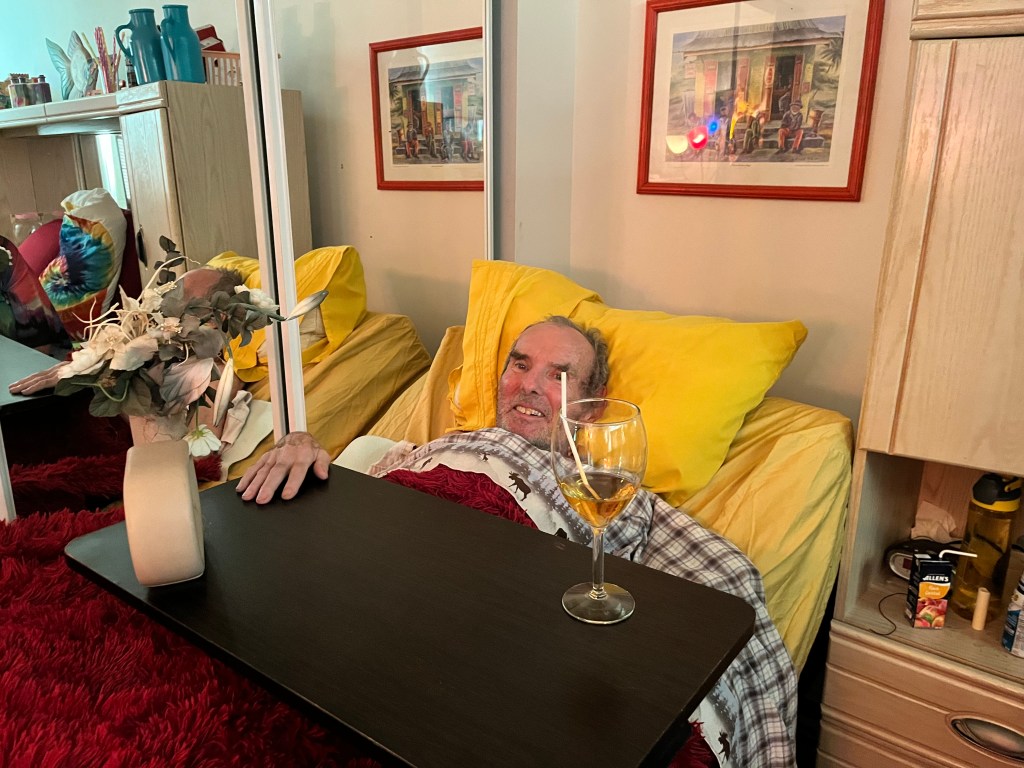
During those last weeks of him being bedridden, visitors became something he looked forward to. Now he wanted company, and enjoyed the time he spent with each family member. We rearranged his bedroom to feel more like a living room, hooked up a DVD player, and later got a Firestick so he could watch rugby and more movies. That little room became his whole world, and every time he woke up, he’d ask, “Who’s coming to visit today?” We did everything we could to keep that space feeling alive and fun, for as long as possible.
Caring for him at home took an army of nurses, a hospital bed, and—ironically—the colostomy bag that had marked the beginning of this long, painful journey. In the end, that very bag made it possible for us to care for him at home, right where he wanted to be. My husband, Tom, also played an important role. Dad often asked, “Where’s Tom today?” and whenever Tom visited, his face lit up. With caring strength and tenderness, Tom took on the physically demanding tasks that the rest of us struggled with, and even now, when I think back on how he stepped up, I feel a deep, abiding love and gratitude for his support.
We did our best to ease Dad’s pain—morphine, gabapentin, steroids, creams, TENS machines—whatever might help. When even a light touch on his arms became unbearable, I found that massaging his feet, calves, chest and head helped to calm him. I reflect on the hours I spent massaging him and I’m thankful for the relief it gave him, not to mention the sense of purpose it gave me when I felt otherwise useless.
When he had stopped eating and drinking altogether, one day out of the blue he said he’d love a popsicle. We got him one, and watching him savor even just a little of that cold treat was beautiful. He didn’t finish much of it, but for that brief time, he looked genuinely happy, and we soaked it all in.
Even in those final days, when we had to rouse him at odd hours to check his ostomy bag or inject medicine, he never lost that gentle charm. No matter what time it was, when he opened his eyes, even with his voice weak and raspy, he’d greet us in his smooth English accent with, “Good morning, my darling!” It always made me smile, even as my heart broke.
Eventually, the side effects of his pain meds made him agitated and restless, desperate and unable to find comfort. The nurse suggested sedation—medicine that would allow him to sleep as he took his final journey. She also mentioned that he might need some time alone in order to let go – death can be a private matter for some. As strange as it sounded, we followed her advice. After everything we had done to be by his side, we now stepped back.
The next morning, I came to visit as always, but tried not to hover over him too much. While I sat with him, I paid close attention to his breathing. He had this strange pattern—rapid breaths, then long pauses. It reminded me of holotropic breathwork, and I theorized that his body was releasing endogenous DMT to help ease him into whatever comes next. If it felt anything like the breathwork I had done in the past, he was flying high! I pondered this as I walked home briefly to work out, take a shower, and catch my breath, assuming we still had some time.
When I returned, I found my mom sitting quietly on the edge of her bed, staring at my dad. Her expression told me everything: he was gone. No matter how much you try to prepare, seeing a loved one’s lifeless body hits you like a ton of bricks. I comforted my mom, made the necessary calls, and tried to process the reality of his passing. We had honored his wish to pass at home, and I know we did everything we could. We helped him eat, injected him with morphine, sat with him through countless WWII movies, and got him those popsicles he wanted at the end. I wish I’d been able to say one last goodbye before the sedation, but I also know I did my best to be there in whatever way he needed, right until the end.
For anyone who finds themselves in this role, I won’t lie: it’s physically demanding and sometimes frustrating. But the joy of helping someone who cared for you all your life can keep you going when you feel like you have nothing left. Providing that selfless service, being fully present in someone’s final days, is its own kind of gift. I learned that while we can’t control death’s timing or manner, we can choose how we show up. I gave him my time, my hands, my heart, and that will stay with me always.

 Psychetopia
Leave a comment