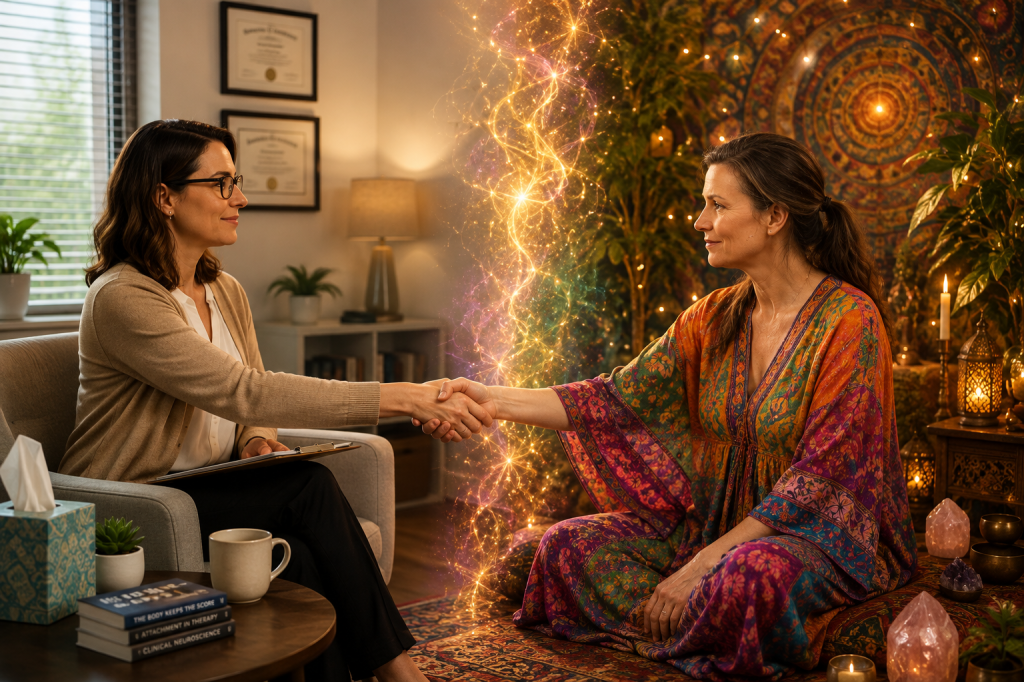
A resource for therapists whose clients are considering psychedelic work
If a client tells you they’re considering a psychedelic experience, you may want them to have support from someone who understands both the experience itself and the importance of careful preparation, screening, safety and integration.
That’s where I can help.
I’ve spent more than 20 years working one-on-one with people through healing processes, including many years as a bodywork therapist and instructor. My experience with psychedelics spans more than a decade. In more recent years, I’ve brought those two paths together through formal training and a professional focus on psychedelic preparation, facilitation and integration.
I work transparently with clients about the legal and practical realities surrounding psychedelic use, with harm reduction and informed decision-making at the centre of the conversation.
My role isn’t to replace the therapeutic relationship you’ve already built with your client.
It’s to support them before, during and immediately after the psychedelic experience, and then help them bring what emerged back into the deeper therapeutic work they’re already doing with you.
Where Our Roles Meet
I don’t want to become your client’s therapist.
In fact, one of the reasons I’d like to develop relationships with psychologists, psychotherapists, social workers and other mental-health professionals is because I think these roles can complement one another beautifully.
You know your client.
You understand their history, patterns and therapeutic goals.
I understand psychedelic experiences and how to prepare for, support and begin integrating them safely.
Neither of us needs to do the other’s job.
You Don’t Have to Become a Psychedelic Practitioner
Your clients may be curious about psychedelics, or may already have decided to explore them, while you may not be in a position to participate directly in that part of their care.
That’s where I can step in.
You can remain within the scope and boundaries of your own practice while I provide the psychedelic-specific preparation, facilitation and early integration. With your client’s consent, relevant insights can then come back into your therapeutic relationship, where the deeper work can continue.
You don’t need to facilitate a psychedelic experience yourself to help your client approach one with greater preparation, support and care.
You remain their therapist. I support them through the psychedelic experience.
Then the work comes back to you.
My Approach
My work is grounded in a few principles that matter enormously to me:
Safety before experience.
Wanting a psychedelic experience doesn’t automatically mean someone should have one.
Consent is ongoing.
Especially when touch or bodywork is involved, consent is discussed beforehand and remains something that can change at any point.
The experience belongs to the client.
I don’t tell people what they should experience or what something must mean.
The medicine isn’t the whole process.
Preparation and integration matter enormously. A psychedelic can open something. What happens afterward is often where the real work begins.
Collaboration is better than working in silos.
When a client already has a trusted therapist, I see that relationship as an asset, not something to replace.
Before. During. After.
BEFORE | Preparation & Screening
A good psychedelic experience starts long before someone takes a psychedelic.
I spend time getting to know each person, why they’re considering this work and what they hope to explore. We talk about expectations, fears, medications, physical and mental health history, previous psychedelic experiences and anything else that may affect their safety or experience.
Preparation may include:
- Comprehensive intake and screening
- Medication and contraindication review
- Education and harm reduction
- Intention without expectation
- Consent and boundaries
- Preparing for difficult or unexpected experiences
- Somatic and nervous-system preparation
- Practical preparation for the day itself
Not everyone who contacts me is an appropriate candidate. If something comes up during screening that concerns me, I don’t simply find a way around it. Sometimes the safest recommendation is not to proceed.
DURING | A Safe, Supported Experience
On the day of the journey, my primary job is surprisingly simple:
Keep them safe and give them the space to have their own experience.
I’m not there to direct the journey or tell someone what their experience means.
I provide a calm, attentive container and respond to what the person needs as the experience unfolds.
Depending on the individual and what we’ve agreed upon beforehand, support can include music, sound and vibration, grounding, breath, gentle movement and consent-based somatic or Bowen-informed bodywork.
Sometimes the most valuable thing I can do is very little.
The experience belongs to them.
AFTER | Integration & Returning to Therapy
I provide initial integration support following the experience, helping clients begin to process what happened and notice what may be worth exploring further.
But integration isn’t about turning every image, emotion or thought into a revelation.
Sometimes something profound happens. Sometimes something confusing happens. Sometimes very little seems to happen at all.
My job is to help the client begin unpacking the experience without imposing an interpretation on it.
And then, whenever possible, the deeper work goes back to you.
If the client consents, I’m happy to collaborate with their existing therapist so that relevant material from the experience can become part of the therapeutic work you’re already doing together.
Considering This for a Client?
You don’t need to decide whether psychedelic work is right for them.
And referring someone to speak with me doesn’t mean you’ve endorsed a psychedelic experience.
It can simply mean:
“Before you make this decision, talk to someone who understands it and takes safety seriously.”
I’m always happy to have a brief conversation with a therapist before a referral, answer questions about how I work, or discuss whether I might be an appropriate resource for a particular client.
Let’s Talk
Amber Gillie
Psychedelic Preparation, Facilitation & Integration
Contact me here
 Psychetopia